Gaseous product of explosion have been modelled to support the formulation of energetic compositions suitable to be used in underground tunnelling and mining operations.
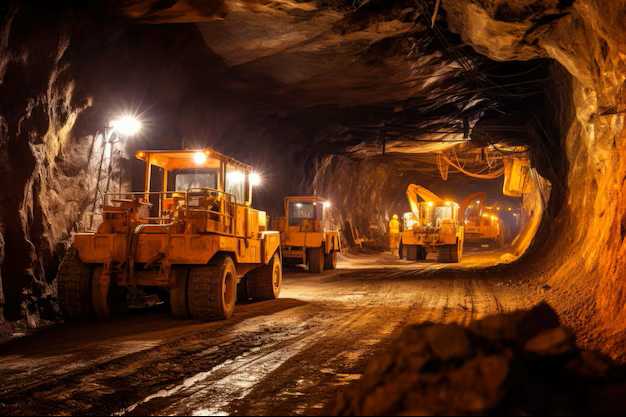
At Syntech International Srl, we were recently tasked with supporting the modelling of explosion gases generated during excavation and demolition activities involving energetic formulations. When either deflagrating or detonating charges are used underground, it is essential to ensure that the resulting gas composition complies with the technical directives and lows in force to safeguard both workers and the environment. Indeed the energetic formulation must be properly formulated to both deliver enough power to perform the required demolition work, while noxious gases are kept under control.
Our Approach
We developed an explosion model based on thermodynamic equilibrium at constant volume (isochoric conditions), which is applicable to a fast-developing reaction occurring inside a closed volume. The model begins calculating the enthalpy of formation of the charge mixture, then it calculates the maximum temperature, chemical composition and pressure permitted by the combustion products in thermodynamic equilibrium each other.
- Assumptions: adiabatic, closed-system conditions, kinetics rapid enough to establish the thermodynamic equilibrium;
- Boundary conditions: inclusion of the most relevant high-temperature compounds and radicals, such as:
CO₂, H₂O, N₂, O₂, H₂, CO, NO, HCN, CH₄, C₂N₂, C₂H₄, C₂H₆, CH₃OH, CH₃CH₂OH, CN, N, O, H, OH;
Results and Benefits
Our model aligns closely with more complex computational approaches, while providing crucial insights to:
- Optimize the formulation of energetic charges
- Improve the quality of combustion gases
- Enhance safety and environmental conditions in underground tunnelling and quarry operations
By combining scientific rigor with practical application, Syntech International Srl with its model has contributed to safer, cleaner, and more sustainable underground works.
References.
[1] Encyclopaedia of Explosives and Related Items, Volumes 1-10 (1960).
[2] The Chemistry and Technology of High Explosives. Parts I-III (1961).
[3] Chemistry and Technology of Explosives, Volumes 1-4 (1964).
Author.

Luigi Ambrosi, M.Sc.
Process Chemist – Registered in Italy (BS)
Co-Founder and Chief Scientist at Syntech International Srl
l.ambrosi@syntechinternational.com
